

A hazardous-area wireless network should separate four decisions: safety qualification, field connectivity, transport and OT-system integration. Explosion-proof access points provide local WiFi, wireless bridges extend Ethernet between locations, cellular routers provide IP backhaul, and DTUs carry focused telemetry. No single device replaces a site classification, RF survey, network-security design or certificate review.
What does a practical architecture look like?
A common pattern is:
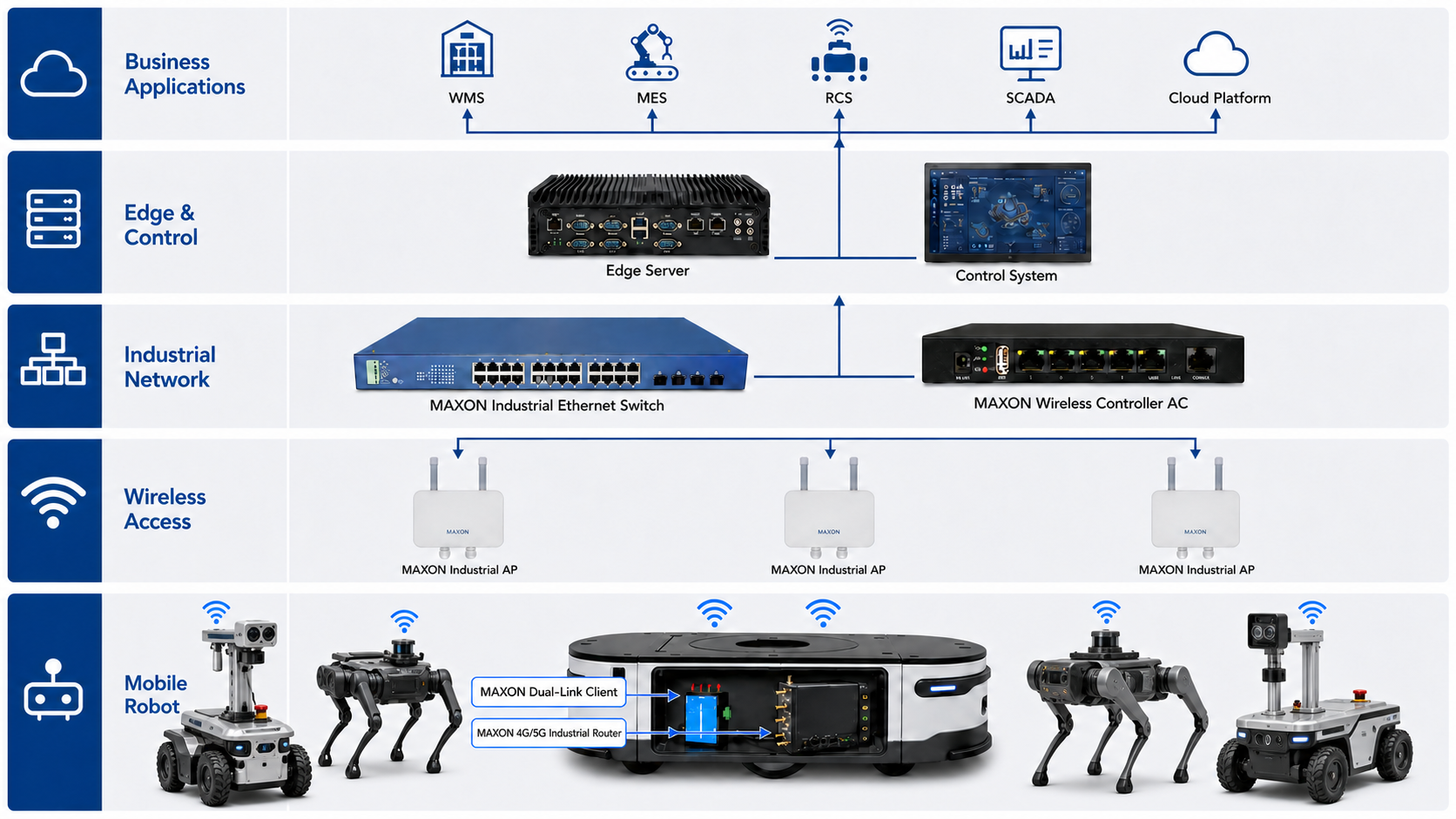
The diagram is deliberately functional. The physical design may use separate safety zones, fibre isolation, redundant rings, point-to-point bridges, private cellular service or segmented WiFi. Each boundary needs an owner and an acceptance test.
Start with the hazardous-area dossier
Before choosing WiFi 5, WiFi 6, 4G or 5G, obtain the site's formal classification. At minimum, record:
· zone or division;
· gas, vapour or dust group;
· temperature class or maximum surface-temperature requirement;
· required Equipment Protection Level or regional category;
· ambient-temperature range;
· accepted certification scheme and authority requirements;
· enclosure, ingress, corrosion and impact conditions.
The complete marking and certificate must cover the supplied hardware. IP68, stainless steel or the word “industrial” cannot substitute for hazardous-area approval.
MAXON explosion-proof wireless products are certified according to CCC and GB/T 3836 standards. With protection levels such as Ex db IIC T6 Gb and Ex tb IIIC T80°C Db, the products provide hazardous area protection equivalent to corresponding ATEX and IECEx classifications for oil & gas, petrochemical, and other industrial applications.
Use an explosion-proof AP for local WiFi coverage
An explosion-proof wireless access point is the local connection point for approved tablets, handhelds, cameras, controllers or wireless clients. It suits areas where multiple devices need IP connectivity within the RF coverage footprint.
AP placement should follow a survey, not a maximum-distance claim. Tanks, pipe racks, vessels, structural steel and moving vehicles create reflection and shadowing. Check both bands independently; a usable 2.4 GHz path does not prove equivalent 5 GHz coverage.
Capacity planning should record application traffic, packet size, duty cycle, latency tolerance, roaming and retry rate. The useful limit is airtime under site conditions, not the largest client count in a brochure.
Use a wireless bridge to connect fixed locations
An industrial wireless bridge carries Ethernet between two or more fixed points. Typical cases include a tank farm and control building, remote pump station, conveyor segment, loading terminal or isolated process unit.
For a point-to-point link, document:
· path profile and antenna heights;
· Fresnel-zone clearance;
· transmit power, cable loss and antenna gain;
· regulatory EIRP limit;
· receiver sensitivity at the intended modulation;
· fade margin in rain, heat and seasonal conditions;
· interference and channel plan;
· alignment, mounting and maintenance access.
Long-range performance cannot be approved from distance alone. The same bridge may behave very differently across an open pipeline corridor and a dense refinery.
Use an industrial cellular router for routed IP backhaul
An explosion-proof industrial router is suitable when a remote location needs an IP network over a public or private cellular service. It may connect PLCs, cameras, edge computers and local Ethernet or WiFi devices, depending on the verified interfaces and firmware.
Cellular selection begins with the operator and country, not the label “global 5G.” Confirm the installed modem, LTE or NR bands, SIM policy, carrier acceptance and antenna configuration for the exact model. MAXON's reviewed public material contains mixed 4G/5G wording on some router and DTU pages; final selection requires a current datasheet and module record.
Network functions also need verification: routing, NAT, VPN type, firewall behaviour, remote management, logging, update process and failover. Do not assume that every industrial router implements the same security features.
Use a DTU for focused serial telemetry
A data transfer unit is often the simpler choice for a meter, RTU, sensor gateway or legacy controller that needs serial-to-cellular telemetry. Its job is usually narrower than a router's: carry data between a serial device and a remote application.
The integration sheet should state:
· RS-232 or RS-485 interface and electrical settings;
· serial framing and protocol;
· TCP, UDP, MQTT or platform requirement, if supported;
· reconnect and buffering behaviour;
· server addressing and keepalive policy;
· time synchronisation and event logging;
· cellular bands and SIM requirements.
A DTU may be sufficient for low-volume SCADA telemetry. Cameras, several Ethernet devices or site-wide routing usually point toward a router architecture.
Connect the hazardous area to the OT backbone deliberately
The backhaul from field equipment should terminate in a controlled OT network. A typical design uses industrial switches, fibre where electrical isolation or distance makes it appropriate, and an OT firewall between field, control and enterprise zones.
Define VLANs and access rules by function. A maintenance tablet, camera, PLC and vendor-support tunnel should not receive identical network privileges. Disable unused services, change default credentials, restrict management sources and log administrative access.
Remote cloud connectivity should pass through a controlled security boundary. Avoid exposing PLCs, AP administration pages or serial gateways directly to the public internet.
Design for failure, not only normal operation
For each wireless path, ask what happens when it fails. The answer may be local control, store-and-forward buffering, a redundant bridge, dual cellular service, wired fallback or a defined maintenance response.
Critical process protection should not depend on an unassessed commercial wireless link. Safety instrumented functions and emergency shutdown systems follow their own lifecycle and independence requirements.
Record the recovery objective for ordinary monitoring, production control, video and safety-related information separately. This prevents a low-priority cloud dashboard from driving an unnecessarily complex architecture while a critical control path remains under-designed.
Example architectures by application
Oil and gas well pad
A DTU can carry serial meter or RTU data when the payload is small. A cellular router is more suitable when the pad includes several IP devices, local WiFi or a camera. The enclosure, gas marking, ambient range, modem bands and antenna arrangement require exact-document review.
Petrochemical tank farm
Explosion-proof APs can provide local maintenance coverage, while point-to-point bridges carry Ethernet to the control-building backbone. Metal obstruction and changing tank conditions make a path survey essential. Fibre may remain the preferred primary path for critical systems.
Steel or metal-dust area
The project must address conductive dust, deposits and cleaning as well as RF blockage. If the classified location requires a dust marking such as Ex tb IIIC T80°C Db, verify it on the exact product certificate. An IP rating alone is not enough.
Mining and conveying
Mine rules differ by jurisdiction and location. Equipment for surface processing, tunnels and mines susceptible to firedamp may fall under different equipment groups and legal frameworks. Do not transfer a Group II gas or Group III dust marking into a mining approval without authority review.
Commissioning evidence to collect
Before acceptance, capture:
1. product labels, serial numbers and certificates;
2. enclosure, entry, seal and grounding inspection records;
3. installed antenna types, orientation and cable details;
4. channel plan and spectrum observations;
5. signal, noise, retry and throughput measurements at test points;
6. roaming results for moving clients;
7. cellular registration, band and failover results;
8. VLAN, firewall and remote-access tests;
9. power-loss and recovery behaviour;
10. final drawings, backups and maintenance ownership.
This evidence creates a baseline for troubleshooting and periodic inspection.
Frequently asked questions
Which comes first: hazardous-area approval or RF design?
Safety qualification is the first gate. RF design then determines whether the qualified equipment can meet coverage, capacity and reliability requirements.
Can one explosion-proof AP cover an entire refinery unit?
Do not plan from a generic radius. Structures, equipment, client radios, bands, interference and mounting positions determine the result. Use a predictive design followed by an on-site survey.
When should fibre be used instead of a wireless bridge?
Use the medium that meets consequence, availability, installation and lifecycle requirements. Fibre may be preferable for high-criticality or high-capacity paths; a bridge can be valuable where trenching is difficult or as a diverse backup.
Can 5G replace plant WiFi?
They solve different access and backhaul problems. Private or public 5G may suit mobility and wide-area service, while WiFi may suit local clients and existing Ethernet applications. Compare device ecosystem, coverage, spectrum, latency, security and operator dependence.
Does MAXON recommend a model from the industry name alone?
No. A useful recommendation requires the hazardous-area classification, destination market, wireless function, distances, client or payload details, power, interfaces and environmental conditions.
Request a network architecture review
Send a site sketch, hazardous-area schedule, link distances, device list, traffic types, existing backbone, carrier information and certification requirements. MAXON can map candidate AP, bridge, router and DTU functions and identify the documents that still require customer verification.