
How does long-range wireless data transmission empower remote monitoring? From 4K video backhaul for forest fire prevention to Industrial IoT sensor networks in remote areas, this article analyzes core technologies such as LoRa, industrial Wi-Fi bridges, and UWB, as well as how WPA3 encryption ensures data security. Discover intelligent monitoring solutions for off-grid outdoor environments.
Why Long-Range Wireless Data Transmission is Essential for Remote Monitoring
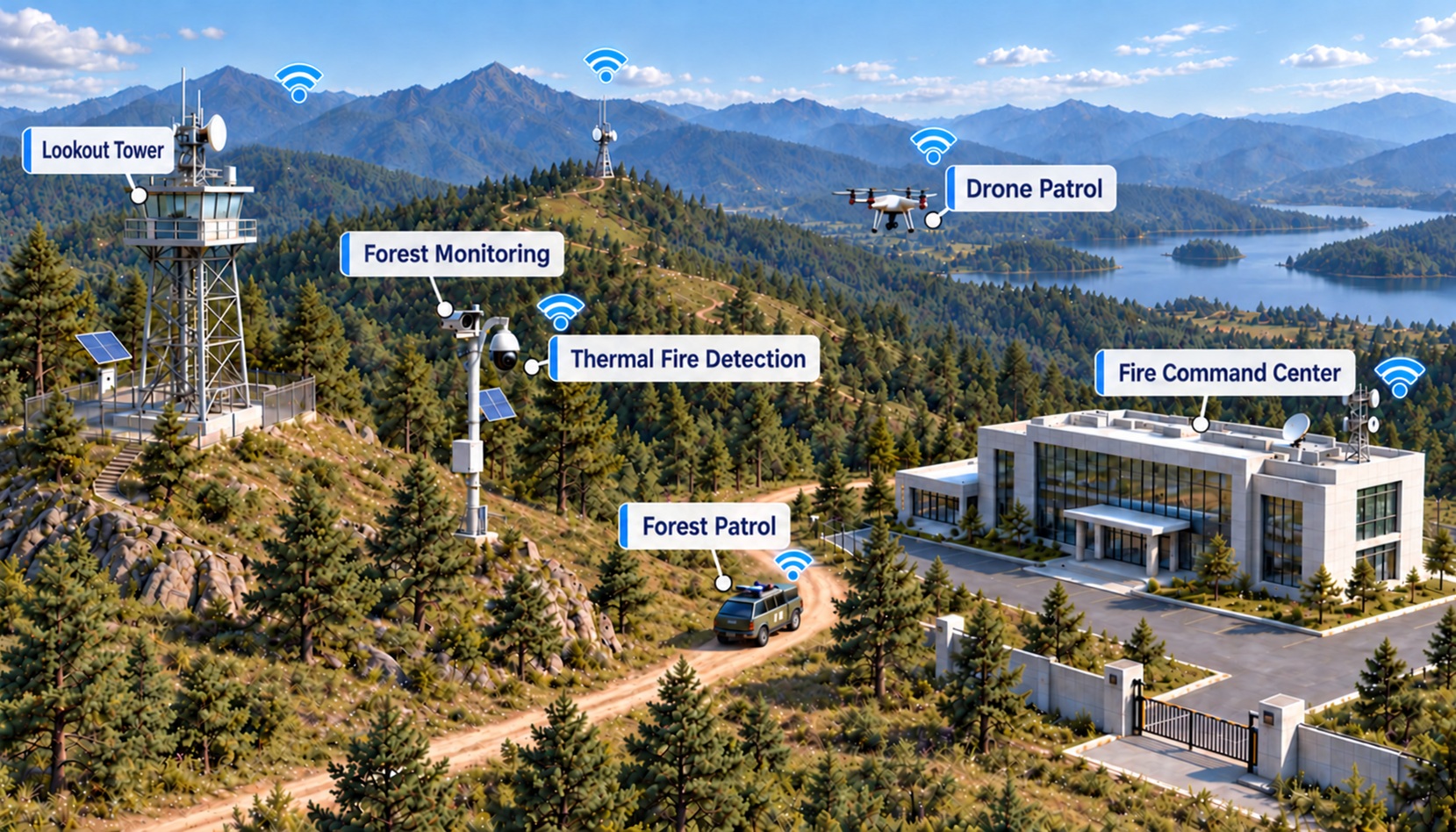
In the era of digital transformation, remote monitoring has evolved from a luxury to a necessity for ecological and public safety. Traditional manual patrol methods are increasingly inefficient, especially in vast, rugged terrains like forest reserves. Long-range wireless data transmission serves as the backbone of modern intelligent monitoring systems, enabling early detection and rapid response protocols in areas where traditional cabling is physically impossible or economically unviable.
Overview of Long-Range Wireless Data Transmission
Long-range wireless transmission refers to the ability to send high-bandwidth data—such as 4K HD video and real-time sensor telemetry—over distances exceeding 20 kilometers. Unlike standard consumer WiFi, industrial Wireless solutions utilize specialized frequencies, high gain antennas, and advanced modulation techniques 1024 QAM to maintain signal integrity across challenging landscapes.
Importance of Secure Data Transmission
In critical infrastructure monitoring, data security is paramount. Unauthorized access to surveillance feeds or sensor data could compromise public safety.
- Protecting Data Integrity and Privacy: Maxonc solutions employ enterprise-level WPA3 encryption and secure VPN tunneling to ensure that every packet of data remains confidential and untampered with from the edge to the command center.
- Regulatory Compliance for Remote Monitoring: Our systems are designed to meet international telecommunications standards CE and FCC,and environmental regulations, ensuring that wireless data transmission do not interfere with existing public networks.
Technologies Enabling Long-Range Wireless Communication
The success of remote outdoor transmission relies on a multi-layered technology stack:
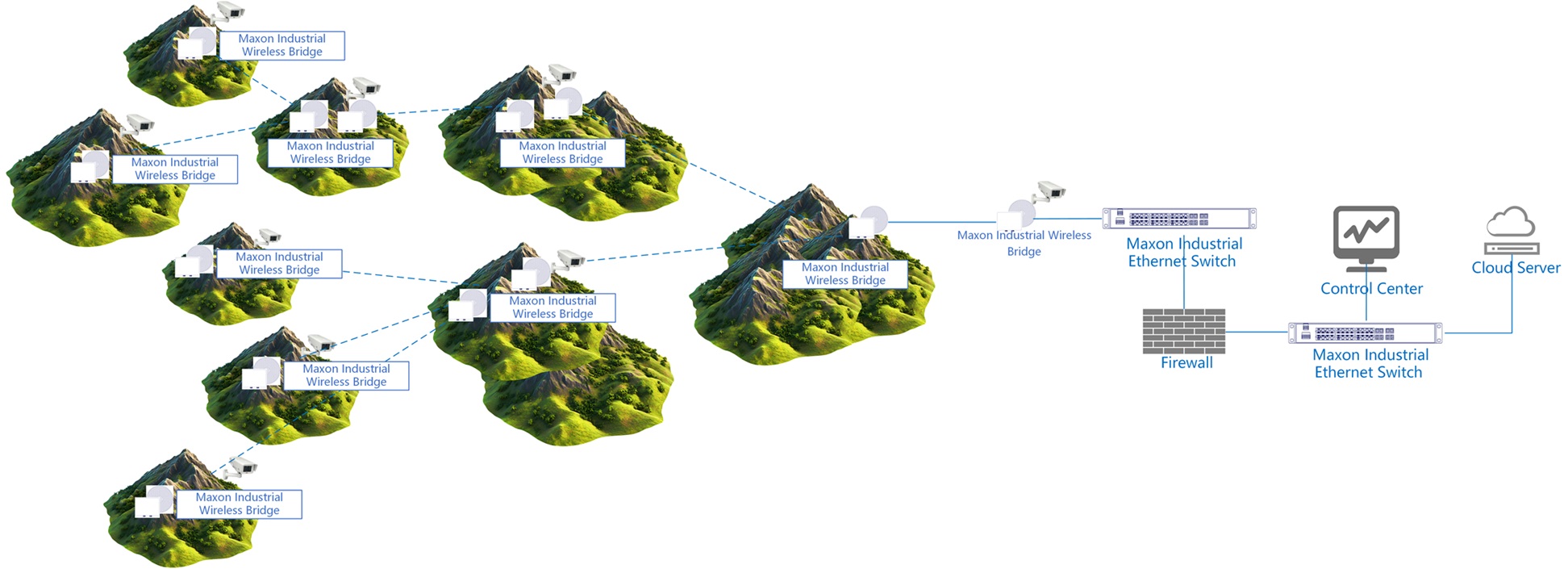
- Industrial wireless Bridges: Utilizing MIMO (Multiple-Input Multiple-Output) technology and high gain wireless antennas to provide hundreds of megabits of bandwidth for video backhaul.
- Low Power Wide Area Networks (LPWAN): Technologies like LoRa are integrated for low-bandwidth, high density access networks that monitor environmental variables.
- Ultra-Wideband (UWB) & GPS: Integrated positioning modules allow for precise tracking of patrol personnel and mobile assets in real-time.
Advantages and features of the solution

Superior protective design
IP68 protection and corrosion resistance design enable the equipment to withstand forest dust and moisture, ensuring long-term stable operation and significantly reducing maintenance.

Ultra-long transmission distance
Through multi-link aggregation transmission, stable and smooth high-definition video transmission over ultra-long distances of up to 20 kilometers is effectively guaranteed.

Superior wireless performance
Supporting 4×4 MIMO technology, it boasts superior wireless performance and a high-gain antenna, delivering a strong signal and providing wide-area coverage and reliable transmission capabilities.

Ultra-low power consumption, long battery life
Integrating LoRa low-power IoT enables accurate wide-area sensor data acquisition and advanced prediction of fire risk levels.
Solution Topology Diagram
Recommended product models and list
|
Category |
Model Series |
Key Features |
|
WiFi 5 802.11ac, IP68 Waterproof and Dustproof, Dual-band, Omni directional Antenna, Dynamic QoS |
||
|
WiFi 6 802.11ax, IP68 Waterproof and Dustproof, Dual-band, Directional Antenna or Omni directional Antenna |
||
|
WiFi 6 802.11ax, IP68 Waterproof and Dustproof, Tri-band, Directional Antenna |
||
|
WiFi 4 802.11n, IP68 Waterproof and Dustproof, maximum distance is 50km |
||
|
WiFi 5 802.11ac, IP68 Waterproof and Dustproof, maximum distance is 5km |
||
|
WiFi 5 802.11ac, IP68 Waterproof and Dustproof, maximum distance is 20km |
||
|
Wi-Fi 6 802.11ax, IP68 Waterproof and Dustproof, directional antenna, Peak Throughput is 2400Mbps |
||
| Wireless Access Point Controller |
Rack-mounted, Max managed APs: 2048 |